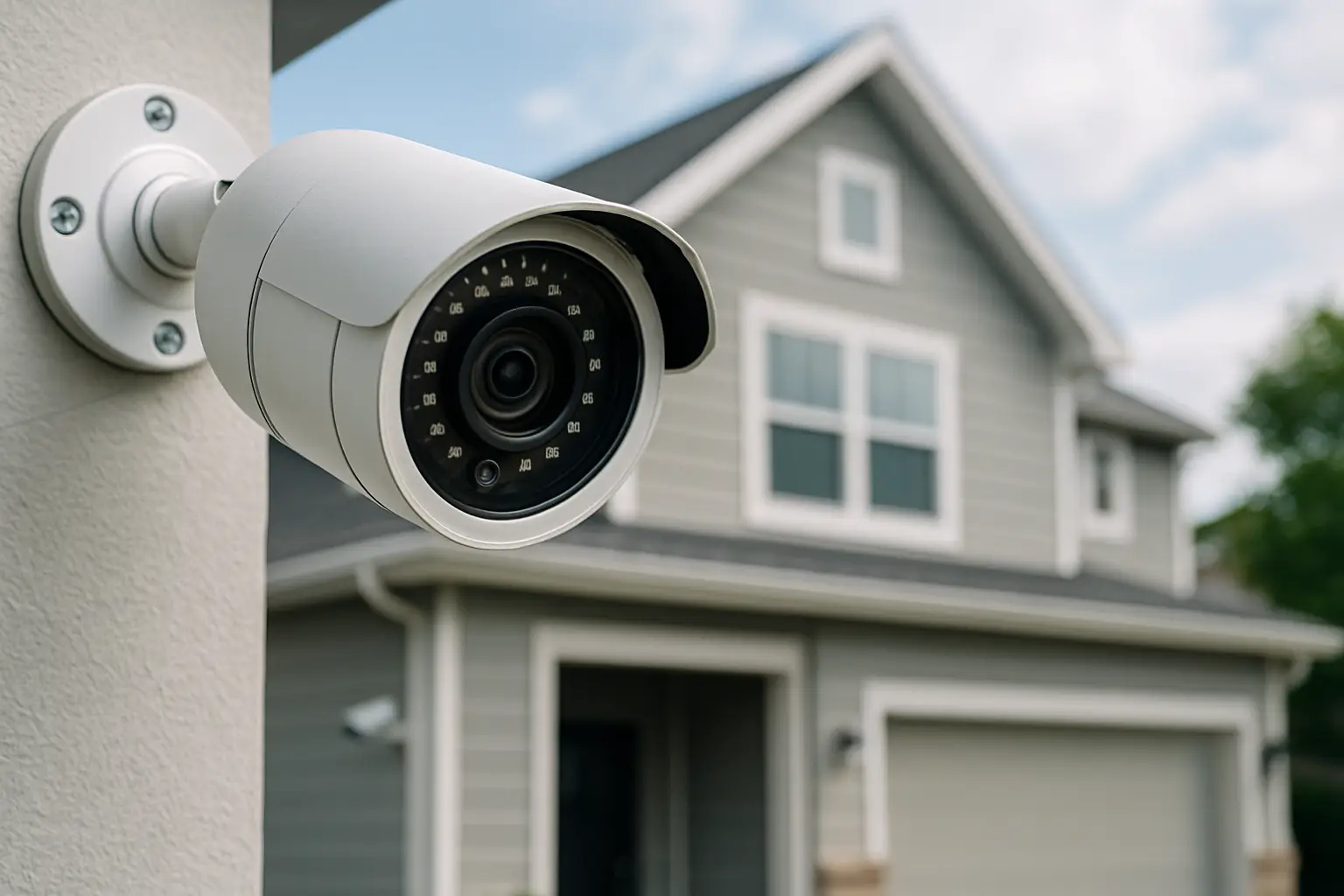
You do not need a camera on every corner of your house. You need cameras where problems actually start - and where footage is most likely to identify a person, a vehicle, or what happened.
Most homeowners ask the same question in slightly different ways: how many cameras does my home need to feel covered without wasting money? The honest answer is that camera count is a byproduct of three things: your entry points, your sightlines, and your expectations for usable video (not just “something happened somewhere”).
Start with coverage, not a number
A lot of camera packages are sold as neat bundles: 4 cameras, 6 cameras, 8 cameras. That is convenient for shopping, but it is backwards for planning. The right way is to walk the property and mark the areas where you would regret not having video.
For most Sacramento-area homes, those areas cluster into two groups: places someone can enter (doors, garage, accessible windows) and places incidents commonly occur (driveway, side yard gates, back patio). When you design around those zones, the camera count becomes obvious.
The “typical” camera counts that work in real homes
Every property is different, but patterns show up again and again.
A small home or townhouse with a single driveway and limited side access often lands in the 3-4 camera range. That usually means a front view, a driveway view, and backyard coverage, sometimes with an added side yard or garage view.
A mid-size single-family home with a front yard, backyard, and two side yards commonly needs 5-7 cameras to avoid blind spots. If you have side gates, a detached structure, or a deeper lot, it tends to move toward 6-8.
Larger properties, corner lots, homes with pools, ADUs, workshops, or long driveways can easily justify 8-12 cameras, especially if you want consistent coverage along the perimeter.
Those numbers are not goals. They are what happens when you try to cover the areas that matter without stretching each camera beyond what it can realistically see.
Step 1: Count your true entry points (then plan to cover them)
Most break-ins are not movie-style “front door kicks.” They are simple opportunities: an unlocked door, a side gate, a garage that was left open for 15 minutes, or a back door hidden from the street.
Your first pass should include the front door, any door from the garage into the home, the garage door area, and the back door. Then look for side gates and any ground-level windows that are easy to reach from a fence line or side yard.
You do not always need one camera per door. A single well-placed camera can cover multiple entry points if the angles are clean and the camera is close enough to capture faces. The trade-off is that wide coverage often reduces identification. You might see someone enter the frame, but not be able to tell who it is.
Step 2: Make sure at least one camera owns the driveway
Driveways are where you get the most useful information: faces approaching, vehicles leaving, and delivery activity. If there is only one “must-have” view for most homes, it is the driveway.
If your driveway is short and straight, a single camera can often cover it well. If it is long, curved, or shadowed by trees, you may need two cameras - one for the vehicle path and another angled for faces at the approach.
This is also where resolution and positioning matter more than people expect. A high-resolution camera helps, but distance and angle still win. A 4K camera aimed too wide from too far away can still produce “nice video” that is not useful for identification.
Step 3: Decide what you expect from nighttime video
Night coverage is where homeowners either feel confident or disappointed.
If your goal is simply to know something happened, a single camera with a wide view and basic night vision can do the job. If your goal is to identify a person at night - especially in darker side yards - you often need tighter angles, better lighting, or an additional camera placed closer to the likely path.
Think about your property after 10 p.m. Are side yards pitch dark? Do porch lights create heavy glare? Are there motion lights that help or hurt visibility? The more challenging the lighting, the more intentional you need to be with camera placement, and that can increase the camera count.
Step 4: Walk your fence line and look for “quiet pathways”
Side yards and side gates are common weak spots because they are out of view from the street and neighbors. They are also where one camera can be asked to do too much.
If you have two side yards, you may need a camera for each side - or one strategically placed camera that captures the gate and the run to the backyard. The key is avoiding long, narrow corridors where a camera sees mostly wall and fence, with the subject too far away to identify.
For corner lots, pay extra attention to the side that faces the street. Foot traffic is usually higher, and people can approach without being noticed.
Step 5: Separate “overview” cameras from “identification” cameras
A practical home system often needs two types of views:
Overview views show what happened across a broad area like the backyard or front yard. Identification views are tighter shots that capture faces at doors, gates, and approach routes.
When homeowners try to make every camera do both, they end up with wide shots everywhere and no clear faces when it counts. A better approach is to let one camera watch the whole yard while another camera handles the door or gate where someone would actually come through.
This is why adding just one additional camera can dramatically improve a system. It is not about more footage. It is about putting at least a couple cameras close enough to capture the details.
Step 6: Consider the inside, but keep it purposeful
Not every home needs interior cameras. Many homeowners in Sacramento prefer to focus outside and keep interior coverage limited.
Interior cameras make the most sense when you want to protect a specific area like an entry hallway, a garage interior, or a room with valuables. They are also helpful if you travel frequently and want confirmation that nobody is inside.
The trade-off is privacy. If you do install interior cameras, it is worth choosing locations that are easy to disable, schedule, or restrict, and placing them where they add real value instead of general “more is better” coverage.
Step 7: Match the camera count to the recording setup
Camera count is not just about mounting hardware. It affects how you record and store video.
A reliable NVR-based system is designed to record 24/7, keep footage locally, and support multiple cameras without relying on spotty Wi-Fi signals at the edge of the property. The more cameras you add, the more you should think about storage capacity, the number of channels on the recorder, and whether you want room to expand later.
If you think you might add cameras in a year, planning for that up front usually costs less than replacing equipment later.
Common camera layouts that work well
For many homes, the most effective layout is not complicated. A strong baseline is front coverage that includes the driveway and porch area, backyard coverage that watches the main patio door, and at least one side-yard view if there is a gate or a path that stays hidden.
If your home has two side yards with gates, or a long side run that leads straight to the backyard, that is where the camera count often increases. The goal is to avoid a situation where someone can move from the street to the back door without ever being clearly captured.
When “more cameras” is the right answer
Sometimes the property truly needs a higher count. That is common with deep lots, multi-structure properties, homes with an ADU, detached garages, workshops, RV parking, or frequent package deliveries. It is also common when the homeowner wants more than security - like monitoring kids coming and going, checking on a pool area, or documenting a recurring problem with vandalism.
The only caution is that more cameras also means more views to review and more decisions about notifications. A thoughtfully designed system with the right angles will feel easier to use than a larger system that generates constant motion alerts.
A simple way to decide your number
If you want a practical rule that works, aim to cover every exterior approach route with at least one camera, then add one or two “close-up” views at the most likely entry points. That usually puts homeowners in a range that makes sense: enough to prevent blind spots, not so many that you are paying for redundant video.
If you would rather have someone map it for your specific layout and explain why each camera goes where it goes, a local installer can do that quickly. [StaySafe365](https://staysafe365.us) designs camera systems around real sightlines and daily routines, so you end up with coverage you can actually use instead of a random camera count.
A helpful way to think about it is this: the right number of cameras is the number that lets you answer two questions without guessing - “Where did they come from?” and “Can I identify them?”